Industrial operations like power plants, refineries, wastewater facilities and LNG transport operations are mission-critical to powering our daily lives. Fires at these key facilities not only jeopardize worker and first responder well-being, but also result in costly infrastructure repairs, unplanned downtime and major societal disruptions to essential services. Preventing these events is both a safety priority and a business imperative.
Given the complexity of these facilities, a variety of gases may be present, requiring different types of detection. Detecting a potential flammable gas leak early before it accumulates, ignites or becomes a devastating fire is a top priority. This is made possible today using multiple advanced technologies in a layered approach to bolster safety.
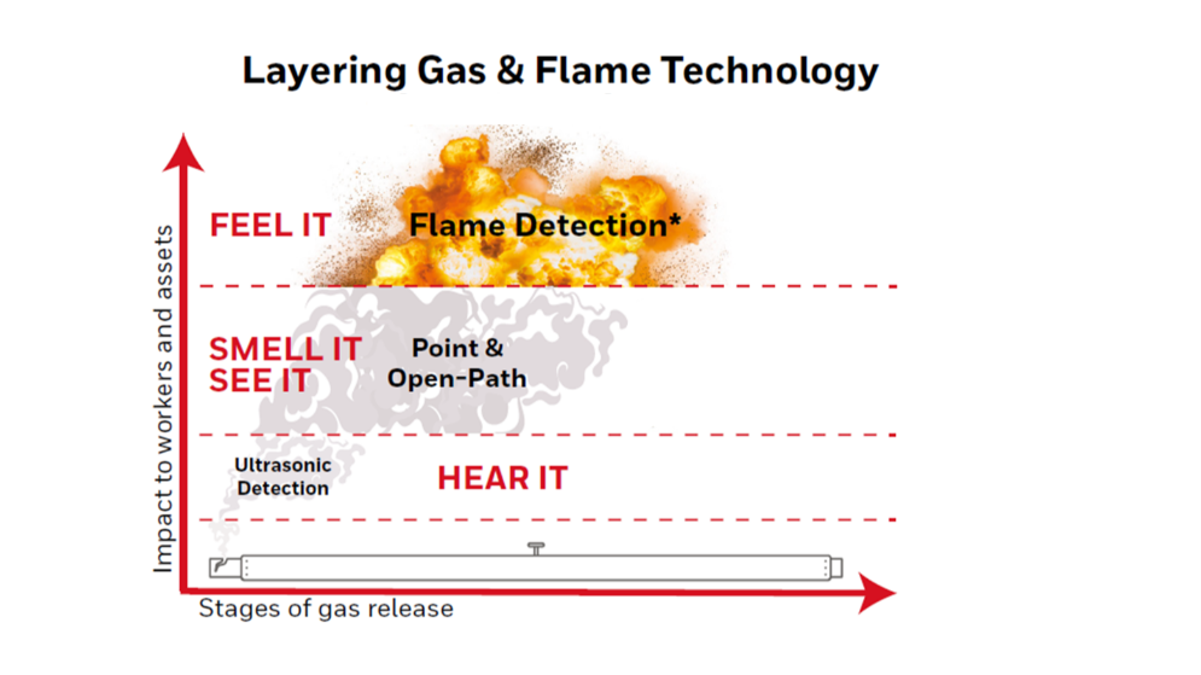
Modern gas and flame detection systems act as the “senses” of the facility, feeding data back to the “brain” of the operation to take mitigating actions. Here’s how each layer contributes:
- Ultrasonic Detectors – The “Ears”
Ultrasonic (or acoustic) detectors respond to the distinct sound pattern created by pressured gas leaks. They can “hear” at a frequency outside the range of human hearing abilities. This is often the first layer of defense or earliest indicator of a pressurized gas leak, since the detector is relying on sound and does not have to wait until the gas reaches a fixed point. These detectors, such as the Honeywell Searchzone Sonik™, are used in open areas like floating production storage, gas turbine power plants, compressor stations, petrochemical processing plants or offshore oil and gas installations. Because they can operate in windy weather, they can catch leaks that would otherwise be missed: according to recent field studies, approximately 30% of flammable gas leaks can go undetected because the gas is blown away by the wind.
- Open-Path Detectors – The “Eyes”
Open path infrared detectors, like the Honeywell Searchline Excel™ Plus and Edge, project an IR beam across a specified distance to measure the average flammable gas concentration along that line of sight. This gives the operation valuable information about leaks that have occurred along the optical path. These types of detectors are often used for perimeter monitoring along the property boundary of an industrial site. The Searchline Excel Edge, for example, is capable of “seeing” up to 1,082 feet for fence-line applications.
- Point Detectors – The “Nose”
Point gas detectors measure gas concentration at a specific location, allowing operators to quickly pinpoint the location of a leak. The Honeywell OmniPoint™, for instance, utilizes multiple sensor technologies simultaneously to address diverse gas detection challenges in global industries like hydrogen storage, LNG transmission, utilities and wastewater. Both open-path and point gas detection solutions represent the second layer of defense against a potential fire.
- Flame Detectors – The Sense of “Touch”
Flame detection solutions, like the Honeywell FS20X Plus, serve as the third layer of defense against fires. They can “feel” once the gas has ignited and created a flame. The FS20X Plus can quickly and reliably detect Hydrocarbon, non-Hydrocarbon, and Hydrogen fires even in the presence of rain, fog and smoke. It uses WideBand IR infrared and ultraviolet (UV) technology to detect fires early so timely intervention is possible.
- The Safety Platform – The “Brain”
To effectively protect people, assets and operations, inputs from ultrasonic, open-path, point and flame detectors must be analyzed, prioritized and transformed into coordinated actions. This is the role of the Honeywell HS-81 Fire & Gas Safety Platform. Acting as the central “brain” of the safety architecture, HS-81 continuously gathers information from gas, flame, smoke and other field devices. It evaluates conditions using pre-engineered safety logic, correlates events from multiple sources and determines the appropriate response based on operational risk.
Once a hazard is identified, HS-81 can coordinate a range of mitigation actions, including activating alarms, initiating ventilation sequences, interfacing with plant control systems, executing emergency shutdown procedures, releasing fire suppression systems and communicating critical information to operators and emergency personnel. By orchestrating information flow between sensing technologies and protective systems, HS-81 transforms individual devices into a unified, intelligent safety ecosystem. The result is faster decision-making, more effective incident mitigation and greater resilience for critical industrial operations.
Conclusion
When a leak occurs or a flame ignites, every second counts when it comes to safety, cost and operational continuity. Detecting gas leaks early and preventing fires before they cause significant damage and personnel risk takes essential inputs from multiple senses fed effectively into the brain so it can take quick action. Today’s advanced safety technologies, layered appropriately, can help even the most complex industrial operations gather data precisely and act effectively to reduce their risks. By combining multiple detection technologies into a unified, layered approach, operators can gain earlier visibility, faster response and better outcomes for people and operational uptime.
*photo credit: Honeywell