
The people behind OT cybersecurity: four career journeys securing today's connected world
Cybersecurity professionals don't follow a single path into the OT industry. Whether their interest in protecting critical infrastructure - and ultimately people, starts in college or it’s a career transition from other fields like engineering, their different backgrounds and varied experiences create stronger security teams.
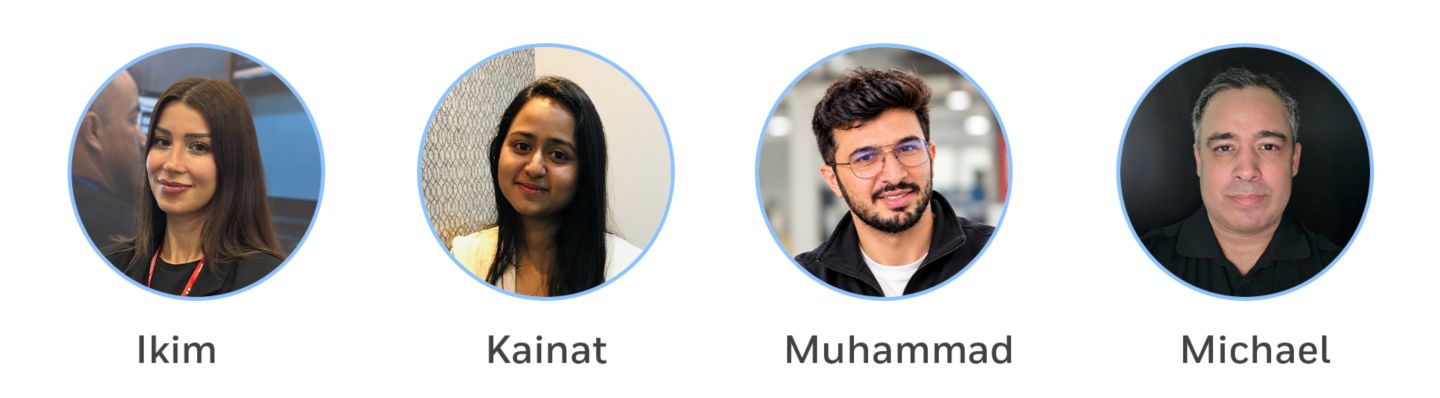
In honor of Cybersecurity Month four of our Futureshapes share their experience in the industry, from how they started studying or working in OT cybersecurity, to what defined their career’s path and the most unexpected parts of their journeys.
Every Cybersecurity Journey Starts Somewhere
Ilkim
How did you first become interested in cybersecurity?
My journey into cybersecurity began during my Computer Engineering studies at university. While software development was a major part of my early studies, I was quickly drawn to networking and communication systems. The deeper I explored networking technologies, the more I became exposed to the fundamentals of cybersecurity, from network architecture and protocols to security principles and threat landscapes. What started as a curiosity about how systems connect and communicate gradually evolved into a passion for understanding how those systems can be secured, protected, and made resilient against emerging cyber threats.
Did you start your career in cybersecurity, or transition from another field?
I started my career in network engineering, a field that shares many common foundations with cybersecurity and is closely intertwined with cybersecurity. In fact, the more I worked on designing, optimizing, and troubleshooting networks, the more I realized that security is inseparable from connectivity. Understanding how systems interact, where trust boundaries exist, and how data flows across environments naturally sparked my interest in cybersecurity and shaped the direction of my career.
Mike
How did you first become interested in cybersecurity?
I first became interested in cybersecurity towards the latter portion of my undergraduate degree program and took my first role as a software engineer developing secure communications products supporting Department of Defense. I have held a role in product and cyber security throughout my entire career.
Did you start your career in cybersecurity, or transition from another field?
I have been in secure products my entire career, however, I pivoted from the engineering domain (building secure products) into my current role of product security, which is focused on working with engineering to design and build secure products.
Kainat
How did you first become interested in cybersecurity?
My interest in cybersecurity started much earlier than my professional career. When I was in school, my brother introduced me to rooting Android phones, experimenting with Kali Linux, and even trying to understand how Wi-Fi security could be compromised. I was fascinated by the idea that technology often had capabilities beyond what was immediately visible, and that with enough curiosity and knowledge, you could uncover hidden features, understand how systems really worked, and sometimes use them in ways they were never originally intended. That sense of discovery was incredibly exciting to me.
My passion was cemented when I started my first job working on one of the world's most widely used banking and financial software applications. Finding security loopholes in such a mature product was both challenging and creative. There were no straightforward answers. Every assessment felt like solving a new puzzle, requiring a different way of thinking. What fascinated me most was that the landscape never stood still. New technologies, attack techniques, and defenses constantly emerged, making cybersecurity a field where learning is a lifelong journey.
What began as curiosity about unlocking extra features on a phone eventually evolved into a career dedicated to understanding how systems can fail, how attackers think, and most importantly, how we can build more secure products and experiences for everyone.
Did you start your career in cybersecurity, or transition from another field?
I started my professional career directly in cybersecurity in Infosys as a Pen-tester, where I assessed banking products and expanded my experience in web and mobile application security.
I joined Honeywell Technologies in 2019 and progressed through a series of technical and leadership roles. This progression has taken me from executing security assessments and reporting vulnerabilities to leading teams, improving security processes, mentoring, and building cross-organizational security communities.
Muhammad
How did you first become interested in cybersecurity?
My interest in cybersecurity really started when I was at another company, working on connecting those old, isolated industrial systems to the AWS cloud. The exact moment you connect the physical world to the internet; security becomes a massive priority. I started working with data diodes and Fortinet firewalls to keep things safe, and I immediately fell in love with the challenge. I realized how high the stakes were, which led me into cyber governance and compliance roles in the oil and gas sector. I wanted to help companies build smart security rules based on real-world experience, not just theory. Today, I'm back in a hands-on role with Honeywell Technologies, taking care of a major energy customer. For me, cybersecurity isn't something I just read about in a book it’s a practical challenge I have watched evolve from the plant floor to the cloud.
Did you start your career in cybersecurity, or transition from another field?
My career didn't start in cybersecurity; I transitioned from industrial automation and control systems. For years, my focus was entirely on the physical side of engineering, working directly with PLCs, DCS, and SCADA systems to keep operations running smoothly. What inspired me to transition was watching the industry evolve. My role shifted into IT/OT convergence, where my job was to connect these traditionally isolated factory-floor systems to the AWS cloud. The exact moment we bridged that gap, I saw firsthand how vulnerable these massive systems became. It clicked for me that you can't have reliable automation anymore without rock-solid security. I became fascinated by the challenge of protecting critical infrastructure, which inspired me to pivot full-time into cyber, eventually moving into governance, compliance, and hands-on defense for the oil and gas sector.
Defining Moments Along the Journey
Ilkim
What has been the most unexpected part of your cybersecurity career?
The most unexpected chapter of my cyber security career began when Honeywell Technologies introduced me to the OT world many years ago. Transitioning from an early career in IT into industrial and critical infrastructure environments revealed a completely different cybersecurity landscape, one where securing systems means protecting not only information, but also the operations and processes that keep industries running.
Was there a defining moment, project, or mentor that influenced your career path?
There were two defining influences on my career. The first dates back to a summer internship during my university years, where I became fascinated by the work of a very experienced network engineer and met the network area for the first time. Beyond answering my endless questions, he spared time to teach me the fundamentals, he challenged me to think differently, encouraged me to learn independently, and helped me discover a genuine passion for networking and technology.
The second was my Operations Manager at Honeywell Technologies. She consistently created opportunities for me to grow, trusted me with highly important projects, and encouraged me to step outside my comfort zone.
Looking back, those experiences taught me that great mentors do more than share knowledge, they create the conditions for you to realize your potential. Much of the enjoyment and curiosity I still bring to my work today can be traced back to the impact of those two individuals.
Mike
What has been the most unexpected part of your cybersecurity career?
The most unexpected part of my career has been the transition from building tailored made secure products into supporting macro level cloud security at scale. The breadth of security concerns and coverage coming from a background of tailored secure devices, was a significant leap.
Kainat
What has been the most unexpected part of your cybersecurity career?
The most unexpected part of my career has been discovering how much cybersecurity depends on people and communication. Technical expertise is essential, but lasting security improvements happen only when testers, developers, architects, product owners, and leaders understand one another.
As I moved into leadership, I learned that success is not only about finding more vulnerabilities. It is also about creating an environment where people ask better questions, share what they learn, challenge assumptions respectfully, and feel encouraged to grow.
Was there a defining moment, project, or mentor that influenced your career path?
There wasn't a single defining moment that shaped my career. Instead, it has been a collection of experiences, mentors, communities, and opportunities that gradually influenced the person and professional I have become.
One significant transition was moving from an individual contributor role into leadership. For most of my career, success was measured by the vulnerabilities I discovered, the assessments I completed, and the technical problems I solved. Stepping into leadership changed that perspective completely. I began measuring impact not only through my own contributions but through the growth of my team, the culture we built together, and the security improvements we could achieve collectively.
Another transformative experience was attending DEF CON in the United States, one of the world's largest and most influential hacker conferences. Being surrounded by thousands of passionate security professionals, researchers, and innovators reinforced the importance of continuous learning and reminded me how rapidly our field evolves. It also highlighted something I have always believed: cybersecurity is ultimately a community-driven profession where knowledge grows when it is shared.
Community involvement has been a recurring theme throughout my journey. I have spent several years volunteering, mentoring, and contributing to security communities. One experience that had a lasting impact on me was serving as a chapter leader for Women in Cyber Security within the Information Systems Security Association (ISSA) Bangalore Chapter. Through that role, I met talented women from diverse backgrounds who were eager to build careers in cybersecurity despite the field traditionally being male-dominated. Seeing their enthusiasm and determination made me appreciate the importance of representation, mentorship, and creating opportunities for others. It has been incredibly encouraging to watch the industry evolve and to see more women enter cybersecurity, take on leadership positions, and redefine what the future of the profession looks like.
Muhammad
What has been the most unexpected part of your cybersecurity career?
The most unexpected part of my career has been realizing that the biggest challenge in cybersecurity isn't the technology, it’s the human and cultural gap between IT and OT. Coming from an automation background, I expected cyber to be all about firewalls, data diodes, and technical configurations. But when I moved into governance and compliance roles within the oil and gas sector, I quickly found out that the real battle is getting two completely different worlds to speak the same language. Corporate IT teams are focused on data privacy, software updates, and rebooting systems to apply patches. But on the plant floor, operational engineers don't care about any of that, their priority is 100% uptime and safety. They can't just reboot a multimillion-dollar asset because of a software update. Bridging that gap, finding compromises, and translating technical cyber risks into real-world business and safety impacts was something I never expected to be such a massive part of my job. It turns out that communication and understanding the business reality are just as important as the technology itself.
Was there a defining moment, project, or mentor that influenced your career path?
My career defining moment is actually happening right now in my current role, maintaining one of our big energy customers. When I joined Honeywell Technologies, I was coming off a long stretch in cyber compliance and governance. Because I had been leading high level compliance and governance strategy for a while, my deep hands-on skills were sitting on the back burner. Transitioning back to Networks and Incident Response team, looking into live alerts and working with advanced tools like Honeywell Technologies’ Cyber Insights IDS, required a fast adjustment. My mentor, our project cyber lead, was instrumental in helping me bridge that gap and master the pace of daily operations. Thanks to that mentorship and the work environment, I am completely thriving today. This project did not just bring me back to my roots; it is shaping me into a well-rounded expert capable of defending our most critical industrial architectures across Europe.
Lessons for the Next Generation of Cyber Defenders
What advice would you give someone considering a career in cybersecurity today?
Ilkim
Don't focus on cybersecurity first. Focus on understanding how systems and communications actually work. The best security professionals I have met were not security specialists from day one. They were engineers, network architects, developers, and operators who developed a security mindset over time. Coming from the network background, I can also say it worked out for me as well.
Mike
Coming from the engineering side gave me a deep understanding of how products should be built securely, the challenges, and trade-offs. Having a deep understanding of the domain and keeping up with latest industry trends and threats is vital to being successful in this domain.
Kainat
Build strong fundamentals, stay curious, and practice continuously. Cybersecurity is broad, so explore different areas before deciding where to specialize. Hands-on labs, capture-the-flag competitions, security research, and real-world problem solving can teach lessons that theory alone cannot.
At the same time, develop communication and business skills. A vulnerability report creates value only when people understand its impact and know what action to take. Finally, do not be discouraged by how much there is to learn. No cybersecurity professional knows everything. The most important habit is learning consistently and being willing to ask questions.
Muhammad
To succeed, you need to get comfortable with physical gear and learn what these systems do on the plant floor. Build a cheap OT home lab to experiment safely and download industrial packet captures to learn how to read protocols.
You must shift from an IT "patch everything" mentality to an "availability" mindset, prioritizing physical safety and continuous uptime. Finally, master how incident response works specifically in industrial settings so you can contain threats without accidentally shutting down critical operations.
My biggest advice is to find a niche like OT (Operational Technology) security, because that is where the real skill shortage is. Don't just chase generic IT certifications. The world desperately needs people who understand how to protect critical infrastructure like oil and gas plants or power grids where cyber risks meet physical machinery. If you can bridge the gap between traditional IT and the engineering floor and learn to communicate with both executives and field operators, you will be irreplaceable.
Why Cybersecurity Is More Exciting Than Ever
Ilkim
What is the most exciting project you've worked on in the past few years?
One of the most exciting experiences of my career came during my engineering role at Honeywell Technologies, when I had the opportunity to design and commission the upper-level network infrastructure and centralized cyber security applications for an offshore platform. Seeing a network architecture move from design to real-world operation in such a mission-critical environment was both technically challenging and incredibly rewarding.
Which emerging cybersecurity trend do you believe will have the biggest impact over the next five years?
When it comes to trends, I think the next major cybersecurity challenge will not be preventing attacks but managing dependencies. Modern organizations increasingly rely on interconnected suppliers, cloud providers, software platforms, AI services, and industrial systems. As a result, cybersecurity will become less about securing individual assets and more about understanding and managing systemic risk across entire ecosystems.
Mike
What is the most exciting project you've worked on in the past few years?
Supporting a large and vital platform, such as Honeywell Technologies Forge, has been exciting and challenging. The vast domains of concerns, along with new technologies and security concerns in generative and agentic AI have been an exciting undertaking.
Which emerging cybersecurity trend do you believe will have the biggest impact over the next five years?
I think AI and especially the growth of Agentic AI.
Kainat
What is the most exciting project you've worked on in the past few years?
One of the things I enjoy most about working at Honeywell Technologies is the opportunity to work across a wide range of technologies, products, and industries. Over the years, I have had the privilege of being involved in securing some of the most innovative and impactful offerings, which means there is always something new to learn and a different challenge to solve.
Currently, the most exciting area I am involved with is Honeywell Technologies Forge, which brings together operational data, domain expertise, and advanced technologies to help organizations improve efficiency, reliability, safety, and decision-making. It is a strategic platform for Honeywell Technologies because it powers the shift from connected operations toward increasingly autonomous operations across industrial environments. Working on Honeywell Technologies Forge security is particularly exciting because the challenges extend far beyond traditional application security. It requires understanding how cloud technologies, connected devices, operational environments, data flows, AI capabilities, and business processes interact, and ensuring security is built into that ecosystem from the ground up.
Which emerging cybersecurity trend do you believe will have the biggest impact over the next five years?
Without a doubt, the biggest trend is AI, and it is not going away anytime soon. What makes this particularly interesting is how quickly the conversation has evolved. Just a couple of years ago, the focus was primarily on securing AI applications and protecting models, data, and prompts. Today, we are entering a world where security teams are not only defending against human attackers but also dealing with autonomous AI agents that can make decisions, take actions, and interact with other systems at scale.
Over the next five years, I believe we will see a major shift toward securing AI-driven ecosystems rather than individual applications. Identity management for AI agents, agent-to-agent trust, access controls, decision validation, model governance, and auditability will become just as important as traditional cybersecurity controls. In my view, organizations will need to carefully balance autonomy with accountability, ensuring that AI can operate efficiently while remaining transparent, controllable, and secure.
Muhammad
What is the most exciting project you've worked on in the past few years?
The most exciting project is the one I am working on right now, maintaining one of our energy customers. After spending a few years focused heavily on cyber compliance and governance, this role brought me right back to the front lines. I am part of the incident response team, where I get to analyze live alerts, figure out if they are legitimate threats, and work directly with Honeywell Technologies’ own advanced tools.
Which emerging cybersecurity trend do you believe will have the biggest impact over the next five years?
The biggest trend over the next five years is going to be the rise of AI-driven threats aimed directly at critical infrastructure and industrial systems. Right now, malicious actors are starting to use automated AI tools to scan for network weaknesses, write malware variants, and launch incredibly smart phishing attacks at a speed humans just cannot match. This is going to have a massive impact on the OT and industrial world, especially in sectors like oil and gas. Because we are connecting more factory-floor systems to the cloud every day, these automated attacks will try to exploit those exact bridges. To fight back, companies will have to rely on autonomous defense tools like Honeywell Technologies Cyber Insights to catch and block threats instantly in real time before a human analyst even reads the alert.
Interested in being at the heart of innovation in cybersecurity?
Explore opportunities at Honeywell Technologies.
