

Honeywell Renewable Diesel™
High quality diesel fuel that emits up to 80% fewer greenhouse gas emissions
With increased global concern on climate change and renewable energy regulations, Honeywell Renewable Diesel helps you comply with regulatory obligations and reduce emissions without sacrificing performance.
Produced with the innovative UOP Ecofining™ process, Honeywell Renewable Diesel has a cetane value of 80 — much better than the cetane value of traditional diesel, which translates to improved operating efficiency. Unlike biodiesel, renewable green diesel is chemically identical to petroleum-based diesel and can be used as a drop-in replacement in vehicles with no modifications required.
Renewable Diesel Advantages:
- Pure drop-in fuel that can be blended in any proportion with petroleum fuel
- High cetane and low density can enhance your diesel pool’s performance characteristics
- Requires no changes to fuel infrastructure or vehicle technology
- Up to 80% lower greenhouse gas emissions with ultra-low sulfur and low NOx emissions
- Excellent performance at both cold and warm temperatures
- Stable, not oxygenated
Learn more about Honeywell Green Diesel:
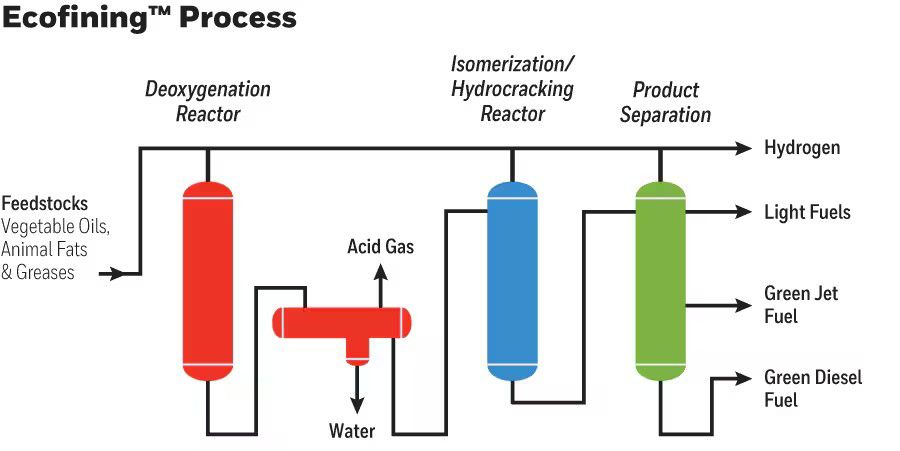
UOP Ecofining Process
The Ecofining process is a versatile solution for producing green diesel fuel from a range of sustainable feedstocks. This allows you to meet regulatory compliance obligations for renewable energy content in the transportation fuels sector and produce high-quality fuel that can enhance the quality of petroleum fuels.
Key advantages of the Ecofining process:
- Feedstock flexible: Process a wide range of oils and fat, without limiting sourcing capability to one type of feed
- Reduce costs and risks of compliance: Make renewable fuels instead of buying them
- High yields: Minimize feedstock consumption
- Attractive economics – impressive payback: High IRR with moderate capital cost
- Standalone: Build a new facility
- Integrated plant: leverage existing infrastructure to reduce capital and operating costs
Honeywell Green Diesel™ vs Biodiesel
Green Diesel is chemically identical to diesel made from petroleum, with one significant difference – up to 85% lower greenhouse gas emissions vs. diesel from petroleum, based on UOP’s lifecycle analysis. Unlike biodiesel, also known as fatty acid methyl ester (FAME), renewable fuel made from our technologies can be used in your current diesel engine, and there’s no need to blend it with other fuels.
Limitations of FAME
- Corrosion concerns: FAME cannot readily use the existing pipeline distribution network due to corrosion, contamination and metallurgy concerns. As a result, fuel has to move via rail or truck – routes that are more costly and less energy efficient than pipeline distribution.
- High density: FAME density is higher than most diesel specifications allow. This means that for each FAME molecule added to the diesel pool, a lighter molecule needs to be removed. This shrinks the overall diesel pool.
- Low blend limits: Due to stability and decomposition issues, many car manufacturers have concluded that FAME should be limited to 5-7 vol% of diesel. If this limit is exceeded, many engine manufacturers will void their warranties.
Honeywell Green Diesel is a superior solution:
- Use existing infrastructure: Refiners can use existing infrastructure and equipment to produce and transport Honeywell Green Diesel, without significant modification, if any is required.
- Lower density: Honeywell Green Diesel is lighter than the average density required of diesel, so when you add a molecule of green diesel, a heavier molecule of a diesel component can be added to compensate. For a refiner, this blending benefit could allow the addition of hydrotreated Light Cycle Oil to enter the pool.
- High blend limits: Honeywell Green Diesel can be used at 100% with no blending required in fleet operations or locations without blending restrictions.
| Comparison of Petroleum ULSD, FAME Biodiesel and Green Diesel | Petroleum ULSD | FAME Biodiesel | Green Diesel |
|---|---|---|---|
| Oxygen, % | 0 | 11 | 0 |
| Cetane | 40–55 | 50–65 | 75–90 |
| Energy Density, MJ/kg | 43 | 38 | 44 |
| Sulfur, ppm | <10 | <2 | <2 |
| Cold Flow | Baseline | Poor | Excellent |
| Oxidation Stability | Baseline | Poor | Excellent |
How does Ecofining Process work?

Reduce Greenhouse Gas emissions up to 80%


