All Aboard: How to build a culture of quality, not just compliance
Compliance simply means a minimum standard was achieved. Quality has further-reaching implications – and more dire outcomes if companies miss the mark. Patient safety, trust and reputation are all at risk when quality falls short.
In a proprietary study issued by Sparta Systems in 2019, 66 percent of life sciences professionals said compliance was their top quality objective for the year – but compliant products aren’t always quality products.
Compliance simply means a minimum standard was achieved. Quality has further-reaching implications – and more dire outcomes if companies miss the mark. Patient safety, trust and reputation are all at risk when quality falls short.
Poor quality has financial penalties too.
In a 2017 study, McKinsey & Company estimated that two-thirds (or more) of a company’s quality costs are spent remediating the effects of poor quality.
In contrast, good quality can have positive impacts on profitability and create key competitive advantages. McKinsey & Company’s report said exceptional quality can even create barriers to entry for some competitors, lower risk, and drive innovation.
Similar but different
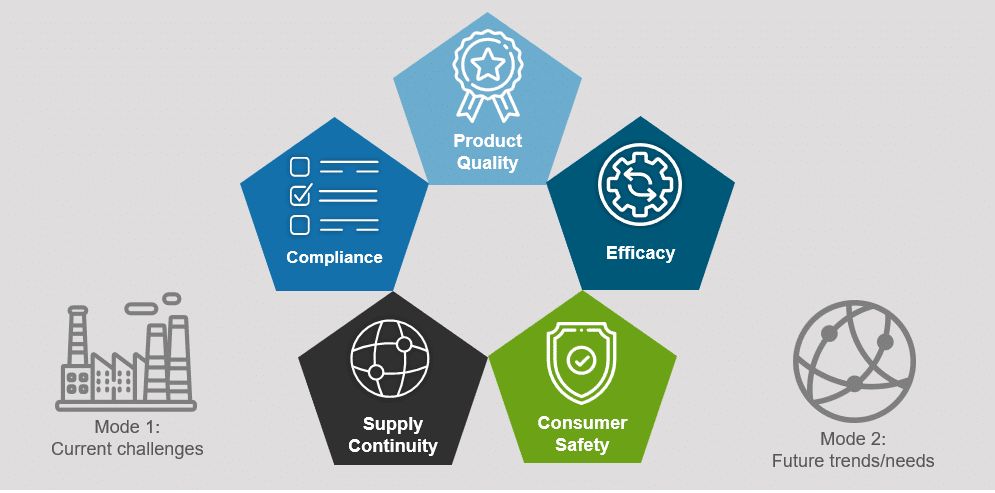
Compliance and quality are related, but have distinctly different processes and outcomes. Compliance is a key element of quality, but it shouldn’t supersede other aspects, like product quality, safety, efficacy, or supply continuity.
Compliance describe tasks that are completed, typically in isolation, and then checked off a list.
Quality, on the other hand, permeates an organization, affecting everything from hiring and R&D to vendor selection and internal change management.
A quality focus affects how teams view their work and connects staff to a greater purpose, like saving lives.
Who’s responsible?
A lapse in quality occurring anywhere in the company can result in serious consequences. As such, quality is everybody’s responsibility.
Despite its extensive reach, too many organizations treat quality as “someone else’s job.” In a survey by LNS Research, 50 percent of life sciences executives said their organization viewed quality as a single department rather than an organizational responsibility.[1]
To achieve consistent, growth-enabling performance, life sciences companies must infuse quality into every aspect of their operations.
Every group and individual that affects the product lifecycle must understand the importance of quality and commit to advancing it.
More than just a pretty slogan
In a Forbes Insights report on the Culture of Quality, 75 percent of senior executives said their corporate culture promoted quality, but less than half of employees with quality job titles believed the same.
Posters and slogans aren’t enough. Life sciences companies need a framework to establish an unshakeable, organization-wide commitment to quality.
Incorporating quality into six organizational components can build a quality-driven culture:
- Policies and decision making: Policies, governance and risk management that affect quality must be enterprise-wide, not just departmental. Quality teams should also have influence on decisions that affect quality, covering both internal and external parties.
- People: Employees should understand how they are responsible for delivering safe and effective products, from design through development, to the point of care and beyond. Training, reporting structures and incentives can encourage team members to put quality first.
- Process optimization: Quality and efficiency go hand-in-hand. Make sure quality professionals are in the right locations globally and have the right skills and resources to affect performance.
- Integration: All elements of quality, including compliance, should be addressed together rather than through siloed approaches. Integrate quality systems and processes, such as complaint management, change control and training. It will be easier to see how quality lapses in one area of the business can cascade – and to proactively resolve issues.
- Data: A single source of master quality-related data can be leveraged to impact performance globally. Data should be accessible and standardized across markets in order to support confident and accurate decision-making.
- Business Insights: Establish key performance indicators (KPIs) that lead toward achieving your overall corporate goals. Balance compliance metrics with measures of all five quality objectives: product quality, safety, efficacy, continuity of supply and compliance. KPIs should measure suppliers’ and external parties’ performance as well as your own.
Life sciences companies don’t operate to comply; they exist to help patients and save lives. To keep patients healthy and safe, life sciences companies need to make quality a key focus of everything they do. Companies that incorporate quality into broader objectives are more likely to achieve all of their goals.
Where does your company stand in the compliance-quality spectrum? Download the whitepaper Balancing Compliance and Quality to find out.
[1] https://www.grantthornton.com/library/articles/advisory/2019/beyond-compliance-improvement.aspx
Recommended for you
-
QMS for Life Sciences - Quality Management
-

QMS Software Patient Safety
-

5 ways technology meets the challenges of complaint handling
-
Quality by Design Article
-
Shaping the Future of Quality RQA
-
Unveiling the Hidden Costs of Recalls in the Life Sciences Industry
-
Sparta Systems and Quartic AI Announce Partnership to Connect Qms to Manufacturing Operations
-
Unlock the Secrets to Streamlined Risk Assessments and Process Improvements
-
ABF-Pharmazie’s Journey with TrackWise Quality Document and Training Management
-
Quality Management New Product
-
Gaining Assurance: A Quality Move
-
Melinda Novatny Integra life Sciences
-
The Evolution of Pharma MES
-
Integrated Risk Management Benefits
-
Get ready for the new european medical device regulation
-
Perform Effective Root Cause Analysis
-
Improving Manufacturing Performance – Moving Beyond OEE to Operational Intelligence
-
What the EU MDR Delay Due to the Coronavirus Pandemic Means for You
-

Alleviate supply chain pressure in the face of a pandemic
-
Root Cause Essentials Continuous Improvement
-
Digital QMS Life Sciences
-
How to build a business case for AI-powered quality
-
How to Choose the Right MES or Manufacturing Operations Platform
-
3 Ways the CAPA Process is Like Preparing for the Big Game
-
Simplify And Standardize the Power of Quality Process Accelerators
-
Virtual Sparta Connection 2020
-
CAPA Management: Technology to the Rescue
-
Legacy Quality Management Systems
-
How to establish supplier qualifications session
-
Honeywell Technologies named a leader in 2026 Quality Management System Technology Value Matrix
-
Prevent Quality Failures: The Power of a QMS
-
Managing Quality Within the Medical Device Supply Chain
-
Remote Supplier Audits
-
Five quality processes AI is transforming in Life Sciences
-
Quality Data Business Technology
-
How to build a business case for QMS investment
-
The Role of QMS During a Global Health Crisis
-
Artificial Intelligence (AI) in life sciences quality management: evolution, impact, and future
-
The Key To Moving Beyond Compliance In 2019
-
Voice Of Customer Sheetal Mane Piramal
-
The Benefits of Integrating Enterprise Quality Management
-
Insud Pharma’s Journey with TrackWise Digital: Transforming Global Quality Management
-
Philips Healthcare Quality Transformation with Trackwise
-
Shawn McKinley Senior Analyst Information Systems Cambrex
-
QMS - Effective Implementation of a Quality Management System
-

How to successfully transition to a cloud QMS
-
3 Types of Batch Technologies to Maximize Productivity and Profitability
-
Quality vs Compliance
-
Prioritizing a Stronger OT Cybersecurity Posture in Life Sciences Organizations
-
Root Cause Essentials Unleash the Power of Your Mind with Mind Mapping
-
3 Benefits of a Cloud-Based Quality Management System
-
Supplier Management Experts
-
Measure What Matters
-
Proactive quality and the bimodal challenge for life science manufacturers
-
How predictive quality is transforming Life Sciences
-
Honeywell Enables Transformation of Life Sciences Manufacturing and Quality Management with TrackWise® Life Sciences Platform
-
Reducing Total Cost of Ownership with an Integrated Pharma Manufacturing Platform
-
Post Market Surveillance Udi Compliance for Class I Devices Moves Forward with New Deadline
-
Why connected data is the foundation for AI in quality management
-
An overview of AI in key quality management processes
-

Expansion Of The Data Integrity Body Of Knowledge
-
A practical roadmap to connected quality in Life Sciences
-
QMS - How Does a QMS Work? Understanding the Core Principles and Functionality
-
7 Must-have quality KPIs
-
Document Management: Communication with Regulators
-
Take the fear out of change with an automated change management process
-
Quality Challenges Facing the Medical Device Industry
-
Document Management Systems: Risks and Solutions
-
Quality Management as a Strategic Technology Partner
-
Digital Audit Management Software
-
QMSR Medical Devices
-
Flipping CAPA on its Head with Prevention and Understanding the True Root Cause
-
Trackwise Digital Video Testimonial From Celonic
-

5 functions that elevate your QMS
-
QMS - Exploring the Key Components of a Quality Management System
-
Why Is a QMS Important
-
Sparta Experts RQA 2021
-
How to meet changing objectives update your quality plan
-
Where Are You on the Quality Management Maturity Spectrum
-
Life Sciences Quality Trends
-
ISO 9001 QMS
-
Integrated Document Management: Leveraging Technology
-
The Patient Centric Passion Behind Sparta Meet Dr Oxana K Pickeral pH D MBA President and CEO of Sparta Systems
-
Why faster decisions have become a competitive advantage in life sciences manufacturing
-
Sparta Systems User Groups
-
Paving the Way to Proactive Quality Tips for a Successful Journey
-
Medical Device Supplier Quality
-
Hidden costs of disconnected quality systems in Life Sciences
-
Five common misconceptions about Quality 4.0
-
The Quality 4.0 Productivity Paradox
-
Voice of Customer Rahul Songire Senior General Manager Cqa Digital Transformation Journey With Trackwise Qms
-
Trackwise Digital Document Control Software
-
Three ways to assess your quality maturity
-
Finalized: EU Publishes GMP Annex 1 Revision
-
Digital CAPA Management Software
-
Quality Best Practices Council
-
From Data to Knowledge: Building Workforce Intelligence in Pharma Manufacturing
-
Document Management a Tale of Two Manufacturers
-
QMS - The Elements of a Successful CAPA Process
-
Olympus Quality Transformation Journey
-
Qms Software Supply Chain
-
Gamp-5-second-edition
-
Voice Of Customer Suruchi Sharma Abbott
-
The Honeywell Life Sciences Applications Suite Leverages the Power of AWS Cloud to Accelerate Innovation
-
Selecting the Right QMS
-
What is MES in pharma manufacturing? A practical guide
-
Digital QMS Value
-
Voice Of Customer Srinivas Hosadurga Cipla TrackWise
-
Uncovering The Root Cause And Overcoming Challenges Along The Way
-
Mastering Modern Recall Management a 6 Part Journey to Excellence
-
Is your quality management decision-making impaired by unreliable data?
-
Strike the right balance between compliance and quality
-

QMS - Unlocking the value: Benefits of implementing a quality management system (QMS)
-
Three Reasons to Take Your Document Management Digital
-
The Power of Integration a Holistic Approach To Quality and Document Management
-
QMS Change Management During the Time of Coronavirus
-
TrackWise Digital Success Series
-
Protect Your Product from the Risks of Supply Chain Complexity
-
Reflecting on World Quality Week
-
DMS Integrated Quality Management
-
Measuring the Success of a QMS
-
Accelerating time-to-market in life sciences manufacturing
-

6 Signs of a flawed risk management process
-
Revolutionizing Quality Management Review From Compliance Task to Strategic Insight
-
Proactive Quality Management in 2020
-
The Elements of a Successful CAPA Process
-
Manufacturing Excellence Platform: An Advanced MES Solution
-
Pharmaceutical Quality Digital QMS
-
How Industry 4.0 is Revolutionizing Life Sciences Workforce Solutions
-
3 Ways Digitalization Can Improve Operational Efficiency in Life Sciences Manufacturing
-
4 Strategies to Transform Life Sciences Manufacturing Workforce
-
Five Reasons OT Cybersecurity Must be an Immediate Priority in Life Sciences
-
5 Ways Technology is Rewriting the Workforce Playbook in Life Sciences
-
Hidden Quality Costs in Life Sciences Manufacturing | Honeywell Technologies